Different Types Of ETF Investments
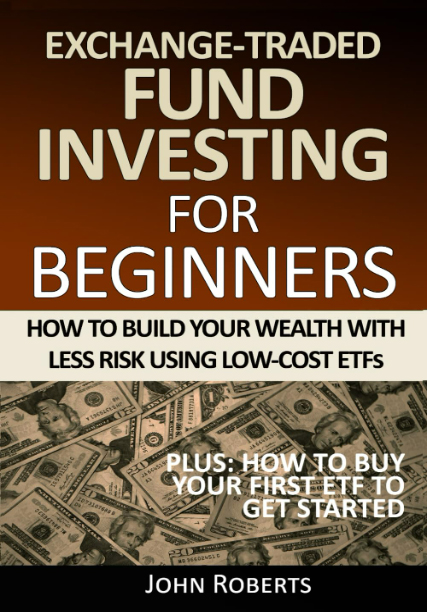
Here’s a sample chapter from my latest book Exchange-Traded Funds Investing For Beginners. The book has been well received, so I’ll, post a number of other excerpts for your review in future posts.
And if it interest you, you can review the book for free right here.
That said, here’s an excerpt from the chapter entitled Different Types Of ETF Investments. It begins like this…
We’re going to continue with our focus on stock-based ETFs for now just to keep things simple and get the overall concept down. And that basic concept is that these stock-based ETFs are made up of a bunch of stocks.
But just another note that ETFs can be made up of other things besides stocks, and the concept is still the same. So here’s a quick preview. There are bond ETFs, which are made up of a bunch of bonds like municipal bonds, treasury bonds, corporate bonds, etc.
Or precious metals commodities ETFs that are made up of a bunch of metals like gold, silver, platinum and palladium. Or even real estate ETFs, made up of a bunch of real estate investment trusts of offices, warehouses, retail centers, apartment buildings, medical facilities, data centers, cell towers, etc.
Get the picture? Now don’t worry if you don’t know much about bonds, precious metals, real estate, etc. because we’ll explain them as we get to them. And you’ll just need to have the overall concept, not be an expert. Because the fund manager takes care of the fund for you.
But for now let’s carry on with stock-based ETFs, because we already know something about them. So let’s start out with large company stock based ETFs because we’ve already talked about a couple of them. And then we’ll carry on from there.
Large US Companies Stock ETFs (Large Cap)
We’ve used a couple of stock ETFs so far to illustrate the general advantages of ETFs. But now, we’ll get more specific. Because they are very popular, and if you buy ETFs, you will probably buy at least one or more of them.
So, as we mentioned earlier, a stock ETF is just an investment in a bunch of different companies’ stocks. But what is a stock?
Well, a stock is an ownership position in a company. So when you buy shares of a stock, you become an owner of that company. Really. You are a legal owner. You get part of the profits (your share), and you have a right to vote.
For example, if you buy shares of IBM stock, you are an owner of IBM. And all the people that work at IBM go to work every day to make you (and thousands of other owners / stock owners) money.
And since you are a legal owner, like we said, IBM will share their profits with you. They do this by paying you a dividend check every three months.
For example, let’s say you bought 10 shares of IBM at $231.50 per share for $2315. IBM pays a dividend of 2.88%, or $6.67 per share annually, which is $67.00 annual dividends for your 10 shares. So they would pay you $16.50 every three months ($67.00 / 4 = $16.50). Or if you own 100 shares, $165.00 every three months, etc.
That sounds like an owner to me.
So when you buy a stock ETF that has IBM as one of its many stocks, you are buying a piece of that action. Now note, in this case the ETF owns the stock and the ETF may or may not pay you the IBM dividend. They may just collect the dividend and increase the value of the fund – which increases your value too.
But the key thing to remember is that buying stocks is buying ownership in a company. And stock funds are made up of a bunch of different companies’ stocks. And you’re buying a stock fund to get a piece of that action, kind of like you actually bought the stock.
And there are many different kinds of stock funds you can buy. Some focus on large companies, or small companies, or all companies, large and small.
Or they can just own US stocks, or international stocks only. Or different market sectors like health care companies, or technology companies, or energy, utilities, real estate, etc.
Or better yet, just dividend paying stocks. I really like these, by the way. I like to be paid to invest my money.
Anyhow, all that said, let’s start off with large US companies ETFs, because we’ve already touched on a couple of them, and I bet they’ll sound familiar to you. Let’s start with a Dow Jones Industrial Average ETF.
EXTRA CREDIT: Large Cap. You’ll often see big companies referred to as Large Cap. That’s short for large market capitalization.
A company needs money invested in it (capital) to start and operate. So if a company has a lot of money invested in it, it’s a big company, a large cap company. And companies with a market capitalization greater than $10 billion are considered “large cap” these days.
You can actually calculate this. You just take the total number of shares outstanding times the value per share to get the capital value.
For example, IBM has 934,000,000 shares of stock outstanding. The price of a share at writing is $231.50 per share. So the market cap is $216,221,000,000 (934,000,000 shares X $231.50 price per share = $216,221,000,000 market cap).
$216 billion is definitely more than $10 billion. So IBM is clearly a “large cap” company.
Okay, so extra credit aside, here is our first large cap stock ETF.
DIA – SPDR® Dow Jones Industrial Average ETF
Investing in DIA is like investing in the overall stock market. The fund is made up of 30 prominent, blue chip companies across key industries in the US. Blue chip companies are nationally recognized, financially sound and well-established companies. They typically sell high-quality, widely accepted products and services, many of which you will probably recognize.
This ETF will sound familiar to you from our discussion on diversification in Chapter 3. It follows the Dow Jones Industrial Average index (the DJIA or DOW). And it pays a 1.96% dividend, which is not bad. Better yet, it has a net expense ratio of 0.16%.
So it represents an overall cross section of the market, is low cost, and pays a dividend. And it’s been around since 1998, so it’s well established. And the DOW is constantly reported in the news – so it’s easy to track.
However, some analysts feel it’s based on an antiquated, somewhat arbitrary index that’s probably more useful to financial professionals than individual investors.
Indexed to: Dow Jones Industrial Average
Expense Ratio: 0.16%
Total Assets: $28 billion
Annual Dividend Yield: 1.96%
P/E ratio: 19.94
Fund Inception: 01/13/1998
Top Holdings:
- UNH UnitedHealth Group Inc
- GS The Goldman Sachs Group Inc
- HD The Home Depot Inc
- MCD McDonald’s Corp
- MSFT Microsoft Corp Technology
- CAT Caterpillar Inc
- AMGN Amgen Inc
- V Visa Inc Class A
- BA Boeing Co
- HON Honeywell International Inc
So that’s the DIA – SPDR® Dow Jones Industrial Average ETF. It’s quite well known and the oldest ETF. In our next post, we’ll look at another ETF.
It’s not as old as DIA, but it is the largest ETF with $381 billion assets under management. That’s over a third of a trillion dollars. And it has the most shares traded daily of all of the ETF’s.
And if you found this sample chapter interesting, you can check out the book for free right here.